


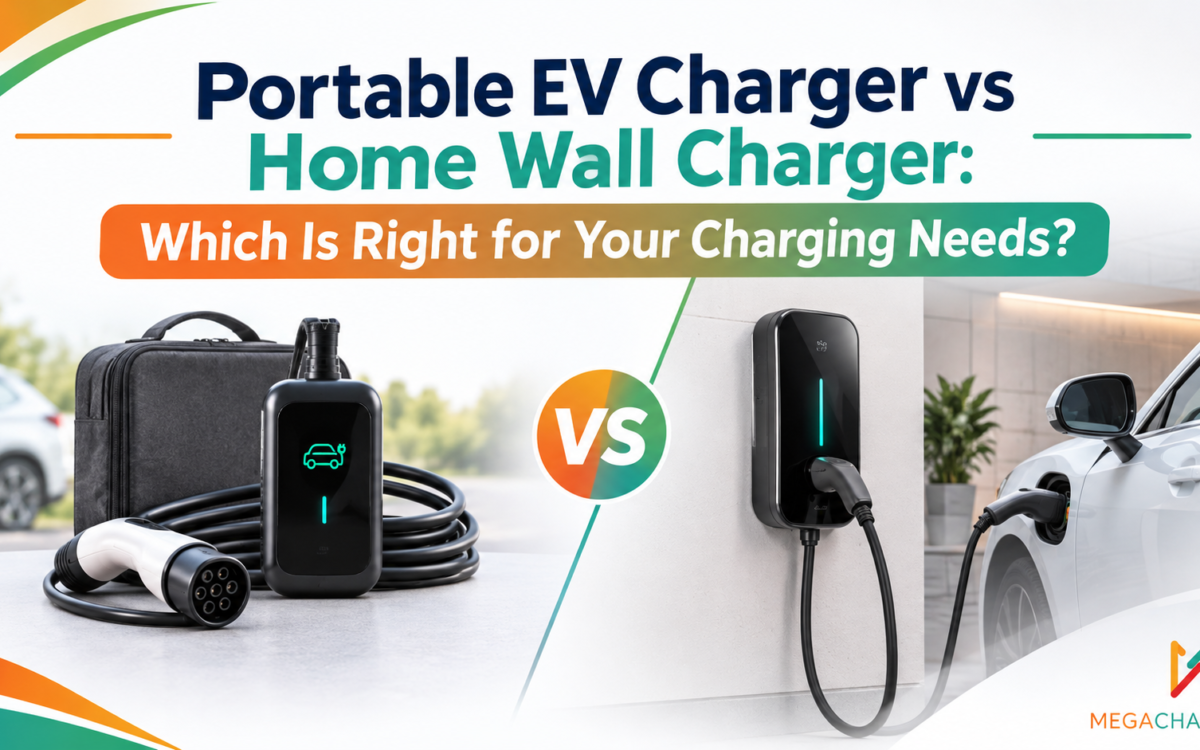
Most EVs sold in India arrive with a cable in the boot and a question in the owner’s mind: is that enough? That cable is a portable electric car charger, and for plenty of drivers, it really is enough. For others, it turns every night into a 15-hour wait. The difference comes down to three things: how far you drive daily, what your home wiring can handle, and how much power your car can actually accept.
This guide gives you numbers instead of hype, so you can decide quickly. We cover how each option performs, what installing a fixed charging point for electric car use really involves, and where public chargers fit in. Mega Charge looks at this decision the way a buyer should, starting from your driving pattern and your wiring, not from the product.
The 30 Second Answer
- At roughly 40 to 50 km a day, with wiring in good condition, the portable charger is a workable start.
- 80 km or more a day, or a car that accepts 7 kW or more: a wall charger pays off quickly in time saved.
- Mostly highway travel: your home setup matters less than the fast chargers on your route.
What Each Charger Actually Is
A portable charger is a cable with a control box that plugs into a standard 15A socket. It typically delivers about 2.3 to 3.3 kW, and most EVs sold in India ship with one.
A wall charger is a fixed AC unit on its own circuit. On a single phase 230V supply, a 7.4 kW unit drawing about 32 amps is the practical ceiling for home charging in India. That means a dedicated circuit, proper earthing and a residual current device, not just a socket on the wall.
Real Charging Times in India
The figures below are approximate for a typical 40 kWh car, based on published Indian charging calculators.
| Setup | Power | Full charge (approx.) |
| 15A household socket | 2.3 kW | About 19 hours |
| 3.3 kW AC point | 3.3 kW | About 13.5 hours |
| 7.4 kW wall box | 7.4 kW | About 6 hours |
For a 40 km day, which uses roughly 8 kWh, a 3.3 kW setup needs about 2.5 hours. A 7.4 kW setup needs about one hour.
One catch saves people real money: your car’s onboard charger sets the limit. A car with a 3.3 kW onboard charger draws only 3.3 kW from a 7.4 kW wall box, so the faster box changes nothing. Check the onboard charger rating before you spend anything. A portable electric car charger is the right match for those cars.
What You Actually Pay For
Electricity costs the same per unit, whichever charger you use, so a wall box does not make energy cheaper. Home power typically runs about ₹6 to ₹10 per unit, and a full charge of a 45 kWh car costs roughly ₹480 to ₹500 on either setup. What you pay for is speed and a safer installation. Dedicated wall units for 3.3 to 7.2 kW commonly cost about ₹15,000 to ₹45,000 depending on brand and smart features. If your sanctioned load does not cover the extra draw, you may also need a load enhancement application with your electricity provider. Mega Charge advises comparing the full installed cost, not just the unit price on the box.
The Wiring Question People Skip
A socket that carries a sustained load for ten hours behaves very differently from one running a lamp. Warm sockets, discoloration, and frequent tripping are signs to stop using it and call an electrician. These are practical recommendations, not regulations: have your wiring inspected, avoid extension cords and adapters, and treat a dedicated circuit as the safer long-term answer. Mega Charge suggests settling the wiring first, because it determines which charging point for electric car charging you can safely use.
Where Public Charging Fits
According to a Lok Sabha written reply dated 21 July 2026, India has 52,718 public EV charging stations, of which 16,561 have fast chargers for cars. Counting methods differ between reports, since one station can hold several points, so you will see other totals quoted. Industry analyses put the ratio near one public charger for every 235 EVs and estimate that only about 55 percent of Indian EV owners have reliable home charging. The takeaway: public charging is growing quickly, but your home setup remains the backbone of daily use.
A Quick Checklist to Choose
Here is the checklist Mega Charge would run through with any driver.
- Daily distance: under 50 km points to a portable, over 80 km points to a wall charger.
- An onboard charger rating of: 3.3 kW means a portable electric car charger is enough. 7.2 kW or more means a wall box can use its full speed.
- Parking: your own dedicated spot suits a fixed box. Shared society parking may need permission first, and a portable unit may be the only practical option.
- Wiring condition: if the socket runs warm, fix that before choosing any charger.
- Renting or owning: a portable charger moves with you, while a wall box stays with the property.
Mistakes That Cost Time and Money
- Buying a 7.4 kW wall box for a car that only accepts 3.3 kW.
- Running a portable charger through an extension cord or a worn socket.
- Skipping the sanctioned load check, then discovering the circuit cannot support the new draw.
- Assuming the portable option is always the budget choice, even when daily mileage makes the slow charge a real daily cost in waiting time.
Key Takeaways
A portable charger is a sensible, low-cost start for light daily use and flexible parking. A wall charger earns its price when you drive more, own a car that accepts higher power, and want a safer dedicated installation. Your car’s onboard charger and your home wiring decide the outcome more than the charger’s brand name.
Before buying, check three things: the onboard charger rating, the condition of your wiring, and your typical daily distance. If you want a second opinion on a specific setup, Mega Charge can help you match your car and your home to the right charger, so you pay only for the speed you can actually use.