


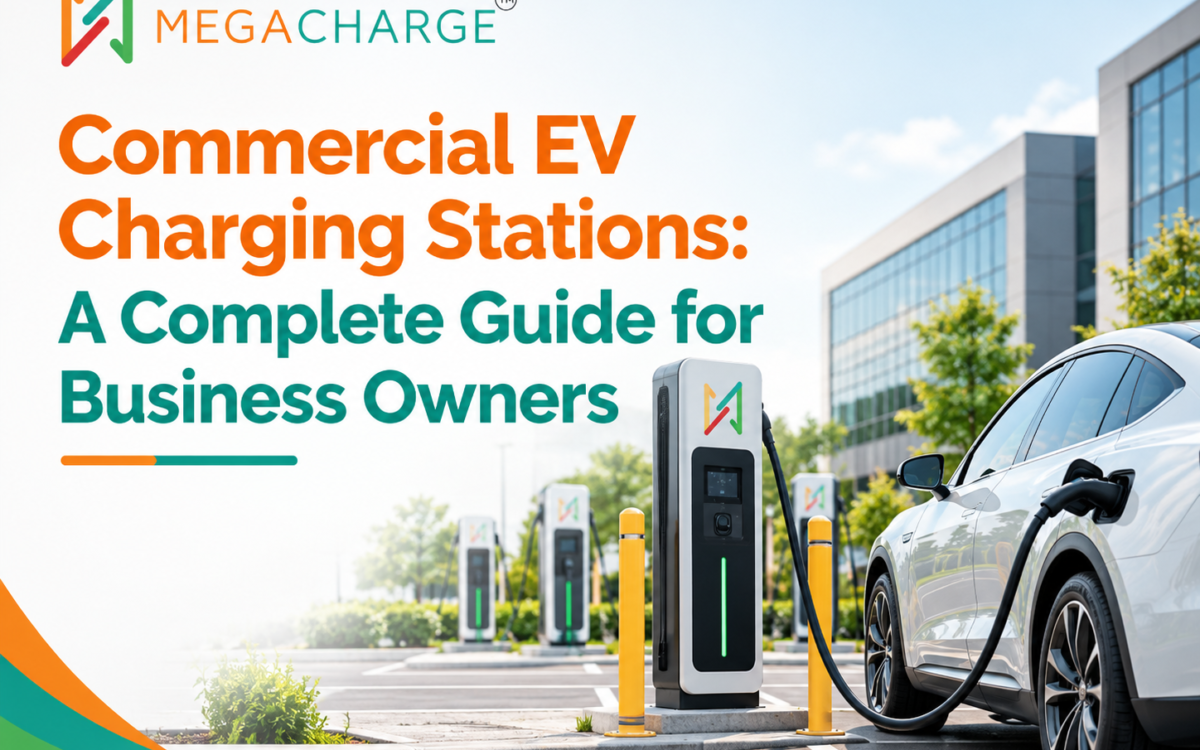
Electric vehicle adoption in India is accelerating faster than most infrastructure planning anticipated. By mid-2026, EV two-wheelers and four-wheelers combined represent a significant and growing share of new vehicle registrations, and the demand for accessible, reliable EV charging points has shifted from a niche requirement to a mainstream expectation among EV owners deciding where to park, dine, stay, and shop.
For business owners, this shift represents both an obligation and an opportunity. Installing the best commercial EV charging stations on your premises is no longer a futuristic investment. It is a decision that affects footfall, customer dwell time, brand perception, and increasingly, regulatory compliance. This guide covers what you actually need to know to make the right decision for your specific business situation.
Why Commercial EV Charging Is Now a Business Decision, Not a Specialist One
The EV driver’s range anxiety has evolved into something more specific: charging point anxiety. Drivers know their vehicles can cover adequate daily distances, but they plan routes, stops, and errands around where they can reliably charge. A retail complex with a functioning EV charging point pulls EV drivers in ways that an identical complex without one does not.
The behavioural data supports this consistently. EV drivers who charge at a commercial location spend more time on the premises than drivers who are simply parking. A hotel guest who can charge overnight is more likely to return. A restaurant with charging stations attracts longer lunch visits. The commercial case is not built on the revenue from charging alone. It is built on what charging enables.
Understanding Charger Types Before Making Any Commitments
The most common early mistake business owners make is selecting charger hardware before understanding what type of charging actually serves their customer base. The three practical categories are Level 1, Level 2, and DC fast charging, each with different power requirements, installation costs, and use cases.
Level 1 charging uses a standard AC supply and delivers approximately 1.5 to 2 kilowatts. It is too slow for most commercial applications. A car charging at Level 1 gains roughly 10 to 15 kilometres of range per hour, which is meaningful for overnight residential charging but largely irrelevant for a customer visiting a commercial premises for a few hours.
Level 2 AC charging is the practical standard for most commercial EV charging stations. Operating at 7 to 22 kilowatts depending on the specific charger and vehicle compatibility, it delivers 40 to 120 kilometres of range per hour of charging. For a retail park, a hotel, a corporate office, or a hospital, Level 2 charging aligned with the natural dwell time of the location makes commercial sense. A customer spending two hours at a shopping centre can add over 80 kilometres of range during that visit.
DC fast charging delivers 30 to 150 kilowatts or more, significantly reducing charging time. It is appropriate for locations where drivers are stopping specifically to charge and moving on quickly: highway rest stops, fuel station forecourts, and dedicated charging hubs. The installation cost and electrical infrastructure requirements are substantially higher than Level 2, and the use case needs to justify that investment.
Mega Charge designs its commercial charging station products across Level 2 and DC ranges specifically for Indian commercial infrastructure requirements, accounting for the local grid conditions, voltage stability considerations, and the actual vehicle fleet composition that businesses are serving.
What the Installation Process Actually Involves
Many business owners are surprised by the infrastructure requirements that precede the charging equipment itself. The EV charging point does not simply plug into an existing socket. A commercial installation requires a dedicated electrical supply circuit appropriately rated for the charger’s power output, a metering arrangement that allows either tariff tracking or billing integration, physical cable routing from the distribution board to the charging location, and civil works for groundwork or mounting structures as required.
For buildings constructed before EV charging was a design consideration, which is most commercial premises in India currently, an electrical capacity assessment is a necessary first step. If the existing incoming supply and transformer capacity cannot support the additional load from the planned chargers, grid upgrade works are required, and these involve the local distribution company rather than just the electrical contractor.
The physical location of the charging points matters more than most people anticipate. EV charging points should be accessible to EV-specific parking bays that are clearly marked and consistently enforced, because a charging point occupied by a non-EV vehicle serves nobody. The cable length of the charger limits where vehicles can park relative to the unit, and this should be factored into the bay layout design.
Revenue Models: How Commercial Charging Actually Makes Money
There are three primary revenue models for commercial EV charging stations, and the right one depends on the business type and the primary purpose the charging serves.
The pay-per-use model charges drivers directly for the electricity consumed, either on a per-kilowatt-hour or per-minute basis. This generates direct revenue from the charging service and is appropriate for publicly accessible locations where charging is the primary offering.
The subsidised or free charging model treats the charging cost as a customer acquisition and retention expense rather than a direct revenue line. Hotels, malls, and corporate campuses frequently use this model, where the cost of providing free or low-cost charging is offset by increased bookings, longer dwell times, and higher customer satisfaction scores. The commercial return is indirect but often larger than the direct revenue alternative.
The employee benefit model applies to corporate offices and logistics operators installing charging for fleet vehicles or employee vehicles. Here the investment case rests on recruitment and retention value, fleet operating cost reduction, and sustainability reporting metrics that increasingly influence institutional relationships and ESG-linked financing.
Mega Charge’s commercial charging solutions are compatible with all three revenue models, with billing software and network management tools that allow business owners to configure the model that fits their specific commercial context rather than being locked into a single approach.
Government Incentives and Policy Context in India
India’s EV charging infrastructure policy has developed significantly since the initial FAME II framework, and business owners planning a commercial installation should understand the current incentive landscape rather than operating on assumptions formed by earlier policy cycles.
The Bureau of Energy Efficiency manages the national charging station certification and interoperability standards that commercial operators must comply with to qualify for government incentives. State-level policies vary considerably, with states including Gujarat, Maharashtra, Tamil Nadu, and Delhi offering specific incentives for commercial charging infrastructure that reduce the net installation cost materially.
Distribution companies in many states offer preferential tariff rates for EV charging loads under specific connection categories, which affects the operating cost calculation for pay-per-use revenue models. Confirming the applicable tariff structure with the local distribution company before commissioning a charging installation avoids assumptions that do not reflect actual operating economics.
The Maintenance Reality That Most Guides Skip Over
Commercial EV charging stations are electrical infrastructure, and like all electrical infrastructure, they require maintenance. A charging unit that is out of service because of a software fault, a damaged cable, a tripped circuit breaker that no staff member knows to reset, or a connector that has been physically damaged by a user is not generating any commercial value and is actively creating negative customer experience.
Before commissioning any commercial charging installation, establish who is responsible for monitoring charger operational status, what the escalation path is when a unit goes offline, how quickly faults will be diagnosed and resolved, and what the service level agreement with the equipment supplier or network operator covers.
Mega Charge provides remote monitoring as part of its commercial charging station deployments, allowing fault detection without requiring on-site staff to manually inspect units and ensuring that response times to operational issues meet the commercial expectations of the businesses the charging stations are serving.
Conclusion
Commercial EV charging is a practical business investment with a clear logic: EV drivers choose where to spend time and money partly based on where they can charge, and businesses that provide reliable, well-located EV charging points position themselves ahead of those that do not.
The decision requires matching charger type to customer dwell time, ensuring the electrical infrastructure can support the load, choosing a revenue model that fits the business context, and putting a maintenance plan in place before the units go live rather than after the first fault occurs.
Mega Charge works with business owners across India to design and install commercial EV charging stations that are appropriately specified for the location, integrated with billing and monitoring systems that make the investment manageable, and supported with the service infrastructure that commercial operations require. The starting point is always a site assessment and a clear conversation about what the business is trying to achieve, which determines everything that follows.