
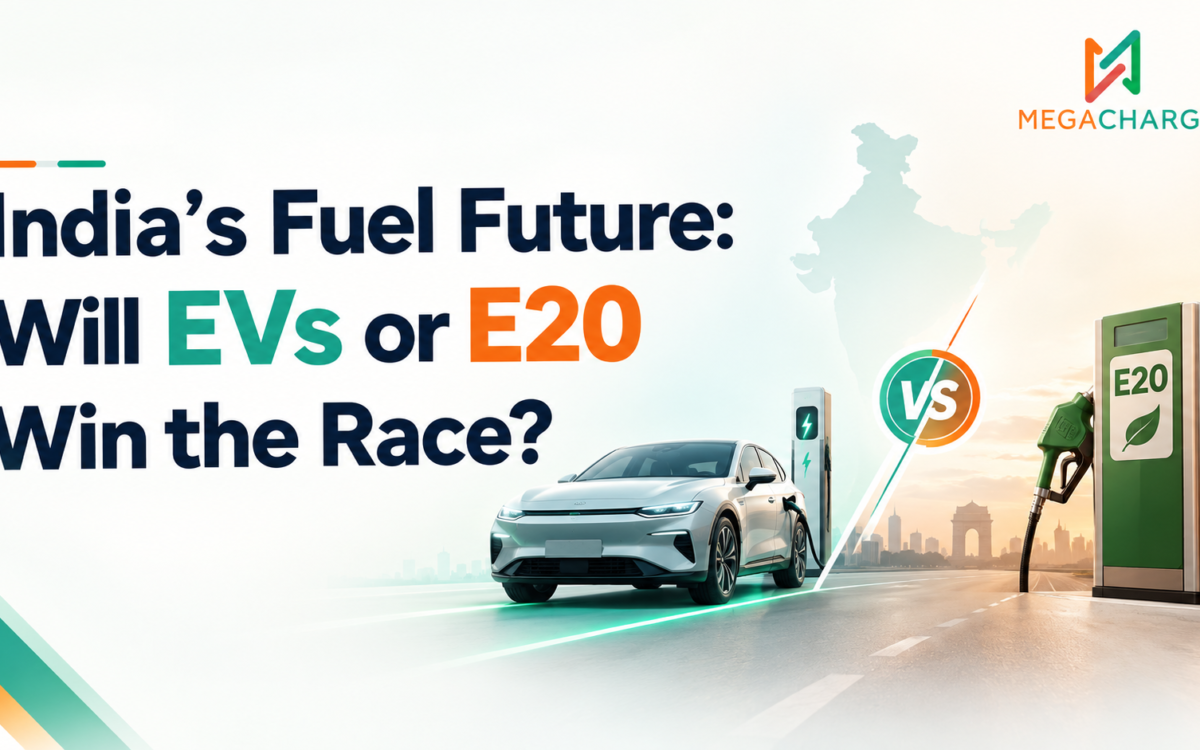
Stand at any fuel station in India today, and you’re looking at two competing visions of the country’s transportation future happening at the same time. On one side, nearly every liter of petrol now flowing into a tank contains 20 percent ethanol, a target the government hit five years ahead of schedule. On the other hand, electric vehicle sales just crossed 2.45 million units in a single financial year, growing by roughly a quarter in twelve months. Both stories are genuinely true, and both are genuinely significant, which is exactly why the question of who actually wins India’s fuel race isn’t as simple as picking a side.
This isn’t an abstract policy debate either. Whether you’re a fleet operator planning your next vehicle purchase, a business weighing infrastructure investment, or simply someone trying to understand where India’s transportation economics are heading, the answer shapes real decisions happening right now. At Mega Charge, we track this shift closely because it directly affects how businesses and individuals should be thinking about charging infrastructure, vehicle investment, and long-term fuel strategy. Let’s look at what the actual numbers say.
The Ethanol Story: A Genuine Policy Success, With a Ceiling
India’s ethanol blending program deserves real credit for what it’s accomplished. The country hit its 20 percent ethanol blending target in petrol in 2025, a full five years ahead of the original 2030 deadline set under the National Policy on Biofuels. Ethanol blending rose from just 1.5 percent in 2014 to 20 percent by 2025, a nearly 13-fold increase over roughly a decade, and E20 became mandatory across all states and Union Territories starting April 2026.
The economic impact has been substantial. The program has saved well over ₹1.9 lakh crore in foreign exchange since 2014-15 by reducing crude oil import requirements, while farmers and distilleries have collectively received more than ₹3 lakh crore in payments for ethanol feedstock, making it one of the most consequential agricultural income programs in India’s recent history. Ethanol production capacity has grown nearly fivefold, from around 421 crore litres in 2014 to approximately 2,000 crore litres today.
But here’s the structural reality that gets overlooked in most coverage: E20 works precisely because it doesn’t require replacing a single vehicle. It decarbonizes fuel for the roughly 350 million existing petrol vehicles already on Indian roads without waiting for fleet turnover. That’s also its fundamental ceiling. Existing E20-compatible engines cannot run on higher blends like E85 or E100 without modified engine calibration and fuel-system components, which means pushing ethanol content meaningfully higher requires an entirely new generation of dedicated flex-fuel vehicles, not just a fuel pump upgrade.
The EV Story: Smaller Base, Dramatically Faster Growth
While ethanol was hitting its ceiling, electric vehicles were compounding from a smaller starting point at a genuinely faster rate. India’s EV market crossed 2.45 million units in FY2026, up approximately 25 percent year-on-year, with all four major vehicle segments, two-wheelers, three-wheelers, passenger cars, and commercial vehicles, posting double-digit growth in the same year for the first time.
The passenger car segment tells the more dramatic part of this story. Electric car sales surged roughly 84 percent year-on-year in FY2026, and by July 2026, monthly electric car registrations were still climbing nearly 83 percent compared to the same month a year earlier. Tata Motors has built a commanding lead in this segment, holding over 42 percent market share, while Mahindra posted more than 125 percent year-on-year growth in the same period, indicating this isn’t a single-brand story but a genuinely broadening market.
Overall, EV penetration reached roughly 8.5 to 11 percent of new vehicle registrations, depending on the measurement period, still a minority of the market, but the growth trajectory matters more than the current share. Electric two-wheelers alone crossed 9 to 10 percent penetration of total two-wheeler sales in early 2026, meaning in some vehicle categories, electrification has already moved well past the early-adopter phase into genuine mainstream consideration.
Why Comparing Them Directly Actually Misses the Point
Here’s the angle most coverage of this topic gets wrong: framing this as a straight race assumes both technologies are competing for the exact same use case, and they’re genuinely not. Ethanol blending is a transition strategy for the enormous existing fleet of petrol vehicles that will remain on Indian roads for years regardless of how fast EV adoption accelerates. Electric vehicles represent the actual replacement pathway for new vehicle purchases going forward.
These aren’t mutually exclusive bet;, but they’re sequential and parallel strategies solving different parts of the same underlying problem: reducing India’s dependence on imported crude oil while managing emissions across a vehicle fleet that’s far too large to replace overnight. A useful way to think about it: E20 buys time and reduces import dependence for vehicles already on the road today, while EV adoption determines what share of tomorrow’s new vehicle purchases run on electricity instead of any liquid fuel at all.
What’s Actually Driving the Shift Toward EVs Right Now
One genuinely underreported dynamic is worth highlighting here: policy uncertainty around ethanol’s next phase is itself pushing some buyers toward EVs. As the government has signaled interest in pushing ethanol blending beyond E20 toward E25 and eventually flex-fuel vehicles running on E85 or E100, consumers who were just getting comfortable with E20 have found the goalposts shifting again. Rather than parse the difference between fuel blend percentages and vehicle compatibility requirements, some buyers are simply opting for EVs, where the policy direction currently feels more predictable and stable.
This matters strategically for anyone planning fleet or infrastructure investment. Confusion around fuel policy doesn’t just create friction; it actively accelerates EV consideration among buyers who might otherwise have stayed on the sidelines longer.
A Practical Framework for Thinking About Your Own Transition Timeline
Rather than waiting for a definitive national answer, it helps to evaluate your own situation against a few practical factors:
- What’s your vehicle replacement cycle? If you’re purchasing new vehicles in the near term, EV growth rates and expanding model availability make electric an increasingly credible option, particularly in the passenger car and two-wheeler segments where growth has been strongest.
- What does your existing fleet look like? If you’re managing a large fleet of existing petrol vehicles with years of useful life remaining, E20 compatibility and fuel cost stability matter more immediately than a full electric transition timeline.
- How exposed are you to regional charging infrastructure? EV adoption has been notably uneven across states, with places like Tripura, Assam, Delhi, Kerala, and Goa showing significantly higher penetration than the national average, largely tied to charging infrastructure maturity.
- What’s your sensitivity to fuel policy shifts? If ongoing changes to ethanol blending targets create planning uncertainty for your operations, that’s a genuine factor favoring earlier EV consideration, not just an emotional reaction to policy confusion.
Key Takeaways
India’s fuel future isn’t shaping up as a single winner-take-all race between ethanol and electric vehicles, it’s a parallel transition where E20 extends the runway for the existing petrol fleet while EV adoption accelerates rapidly in new vehicle purchases, particularly in cars and two-wheelers. Both trends are backed by real, verifiable data, and both are likely to keep growing simultaneously rather than one displacing the other in the near term.
If you’re trying to plan around this shift, whether that’s fleet strategy, personal vehicle purchase timing, or infrastructure investment, the smarter question isn’t which technology wins; it’s which one fits your specific replacement timeline and usage pattern. Mega Charge works with businesses and individuals navigating exactly this kind of decision, helping match charging infrastructure planning to where EV adoption is actually accelerating fastest rather than where the headlines suggest it should be.